 Khandakar Touheed Hossain
What you’ll get from this post
- The 9 things that actually break when Meta ads stop converting on Shopify — in the order I check them.
- The exact numbers that signal each problem (EMQ < 6, LCP > 2.5s, CPM > $14 on AOV < $30).
- A 30-minute audit you can run on your own account before paying anyone for help.
- What to look at when none of the 9 fixes apply.
“Meta ads not converting on Shopify” is the message I receive in my DMs almost every week. Usually at 11pm. The same pattern: “$400 spent this week, 14 add-to-carts, 1 sale — what is wrong with my Meta ads?”
Over the last 18 months I have audited 47 Shopify stores running Meta ads. The interesting part is not that things break. It is that the same nine things break, in roughly the order below. Run through them in order. Most of the time the problem is in the first three. If you make it past number seven and your ads are still not converting, the problem has moved out of the ads and into the offer or the funnel.
First, what “Meta ads not converting on Shopify” actually means
Before you blame the algorithm, agree on the math. If Meta ads not converting on Shopify is the problem you came here to solve, you need a benchmark first.
A healthy conversion rate on Meta traffic for a Shopify store is 0.5%–1.5%. Not a typo. Meta traffic converts lower than Google search traffic because the user clicked from curiosity, not from intent to buy. If you are running 0.8% and you think it should be 4%, the ads are not broken — your benchmark is wrong.
The diagnostic below assumes you are below 0.4% on at least 1,000 clicks and your cost per purchase is more than 1.5x your break-even ROAS. If that is you, keep reading.
Your Event Match Quality is below 6.0
If Meta ads not converting on Shopify is your problem, this is the first place to look. Open Events Manager. Click your dataset. Look at Event Match Quality. If it is below 6.0, you have your first answer.
EMQ is Meta’s score for how well it can match your conversion events back to actual Facebook and Instagram users. Below 6.0, Meta is guessing at half your audience signal — meaning the optimization model is being trained on noise. Advertisers with EMQ above 8 see 15–25% more attributed conversions than those below 6.
You launched Advantage+ Shopping before your pixel had data
Most of the “Meta ads not converting on Shopify” cases I see started here. Advantage+ Shopping Campaigns (ASC) work brilliantly — once your pixel has at least 50 conversions for the model to learn from. In March 2026, Meta dropped the qualifying threshold from 50/week to 25/week, making every smaller store feel like ASC was a free upgrade.
It is not. If you switched to ASC during a launch week with 6 conversions to your name, you handed the algorithm an impossible job. It will burn $200–$400 trying to find a pattern that does not exist yet.
Your product page loads in over 2.5 seconds
Every additional second of page load drops mobile conversion rate by roughly 7%. I have watched a Shopify store double its purchase rate by removing a 1.4MB hero video they did not need.
Open Lighthouse in Chrome DevTools. Run a mobile audit on your top-selling product page. If Largest Contentful Paint is over 2.5 seconds, the ad spend is fine — the page is killing the sale.
Common culprits I find in 8 out of 10 audits: oversized hero images, third-party reviews app, multiple chat widgets, custom font files served from a slow CDN, and theme apps the store does not use anymore.
The ad creative promise does not match the landing page
This is the most underrated reason Meta ads stop converting on Shopify in 2026. The ad uses a hook like “fix your back pain in 30 minutes a day” — and the landing page is a generic product page that talks about belt size, fabric, and shipping.
The user clicked because of a use-case. The page sells them a product spec. The bounce is instant.
Most stores fail Meta ads on tracking and page experience long before they fail on creative or budget.
You are sending Meta traffic to your homepage
Almost every “ads not converting” Shopify store I audit is sending at least one campaign to the homepage. Sometimes all of them. This is a leak.
A homepage forces the user to make three more decisions (which collection, which product, which variant) before they reach the buy button. Each decision is a chance to bounce.
Your AOV is under $30 and your CPM is over $14
Sometimes the ads work. The math does not. Meta’s Q1 2025 average CPM was $10.88. If you sell a $24 product and your CPM is $14, the unit economics quietly disagree with the campaign objective.
Quick math: CPM $14 × CTR 1% = $1.40 per click. Landing-page conversion 1% = $140 per sale at $24 AOV. ROAS 0.17. The campaign is structurally unprofitable.
Your retargeting and prospecting audiences overlap
78% of non-converting retargeting campaigns I audit have the same problem: the prospecting audience is so broad it already includes most of the people who would also see the retargeting audience. Meta then bids against itself, pushing CPM up for both campaigns and burning budget on internal competition.
Your post-purchase event is not firing
If you have suspected Meta ads not converting on Shopify after a theme update — this is usually why. Shopify’s native Meta channel sometimes silently breaks the Purchase event after a theme refresh or app install. The campaign keeps running, but Meta is not getting the conversion signal it needs to optimize.
You are judging the campaign at 48 hours
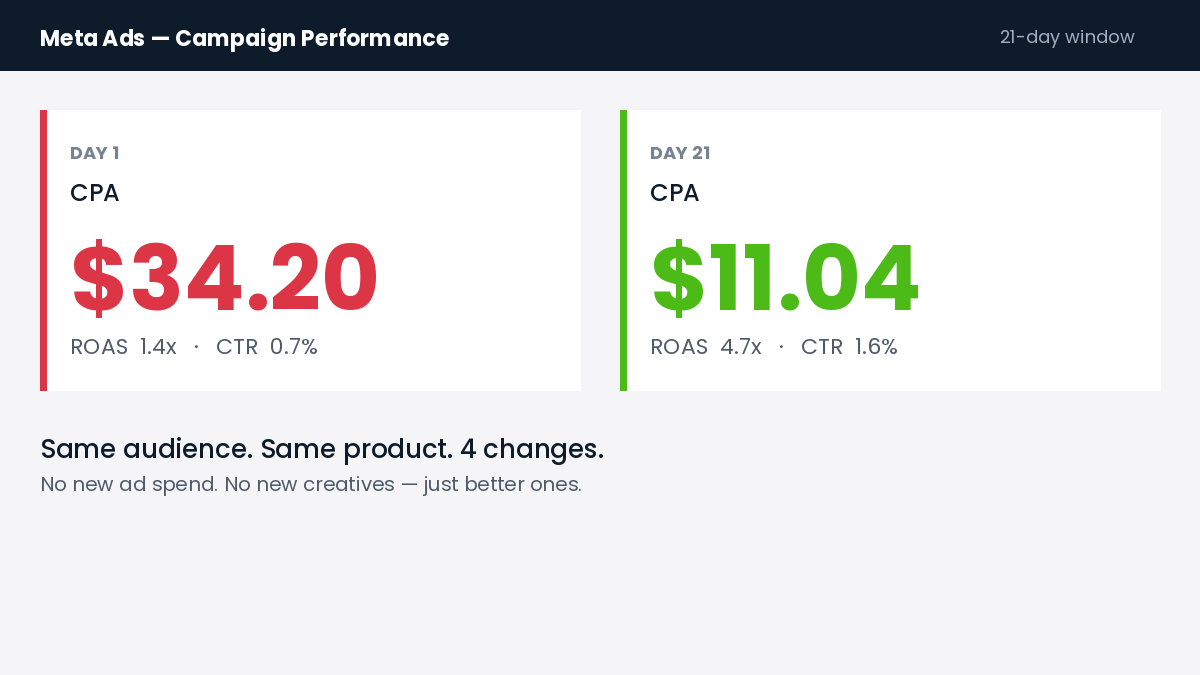
Meta’s learning phase needs 50 attributed events before the algorithm stabilizes. On a smaller budget, that takes 7–10 days. Most store owners pause campaigns at day 2 because they want to “stop the bleeding.”
You are not stopping the bleeding. You are resetting the learning phase. Every pause-and-relaunch starts the count over. That is why your ads “never get out of the learning phase.”
Here is what holding through the 7-day learning phase looks like on a real account:
Run this 30-minute Meta ads not converting on Shopify audit
In 30 minutes, anyone can run this checklist on their own store. Open these tabs at once:
- Meta Events Manager (check Event Match Quality)
- Meta Ads Manager → Audience Overlap tool
- Meta Pixel Helper (open during test purchase)
- Chrome DevTools → Lighthouse mobile audit on your top PDP
- GA4 → Acquisition → Traffic Acquisition → Source = facebook
Fix order: tracking first (1, 2, 8) → page experience (3, 4, 5) → math (6) → audience structure (7) → patience (9).
Frequently asked questions
How long should I wait before pausing a non-converting Meta ad campaign?
Minimum 7 days, or until the campaign has 50 conversion events — whichever comes second. Pausing before 50 events resets the learning phase and wastes the data you have already paid for. The only exception is if CPA is running above 2x your break-even number.
What is a healthy conversion rate on Meta traffic for a Shopify store?
0.5%–1.5% is the realistic range in 2026. Google search traffic converts at 2%–4% because the user already had buying intent. Meta traffic converts lower because the click is curiosity, not intent. If your Meta CR is 0.8% and your AOV is healthy, you do not have a conversion problem — you have a benchmark problem.
Does Advantage+ Shopping always perform better than manual campaigns?
No. Advantage+ Shopping wins when you already have a stable pixel with 25+ weekly conversions and a wide product catalog. Manual campaigns still win for testing new audiences, validating new creative angles, and accounts with under 25 weekly conversions. Most healthy ecommerce accounts in 2026 run a hybrid: 60% budget to ASC, 30% to manual prospecting, 10% to manual retargeting.
Is the Meta Pixel still useful in 2026, or do I only need CAPI?
Run both. The Pixel still captures useful browser-side data (cookie consent permitting), and CAPI fills the 25–30% of events the Pixel misses thanks to ad blockers, ITP, and shortened cookie lifespans. Use deduplication (matching event_id) on both so Meta does not double-count purchases.
Why are my Meta ads not converting on Shopify after iOS updates?
Apple’s iOS privacy updates broke browser-side tracking for roughly 25–35 percent of conversion events. If Meta ads stopped converting on Shopify after an iOS release, what actually changed is not your ads — it is what Meta can see. Server-side tracking (CAPI) closes that gap. Install CAPI through the method that gives you Event Match Quality of 8 or higher, and Meta will start seeing the conversions that were always happening. Reported ROAS typically rises 12–22 percent inside three weeks of a proper CAPI rebuild.
If you have walked through all 9 and Meta ads are still not converting
If you have walked through the list and Meta ads are still not converting on your Shopify store, the problem has moved out of the ads and into the offer or the funnel. At that point you are not looking for a tracking fix or an audience tweak — you are looking at price, positioning, or product-market fit. That is a different post.
Want a second pair of eyes on your account?
I run free audits using the same 9-point diagnostic above. No pitch — you leave with a clear read on what’s broken and what to do next.