 Khandakar Touheed Hossain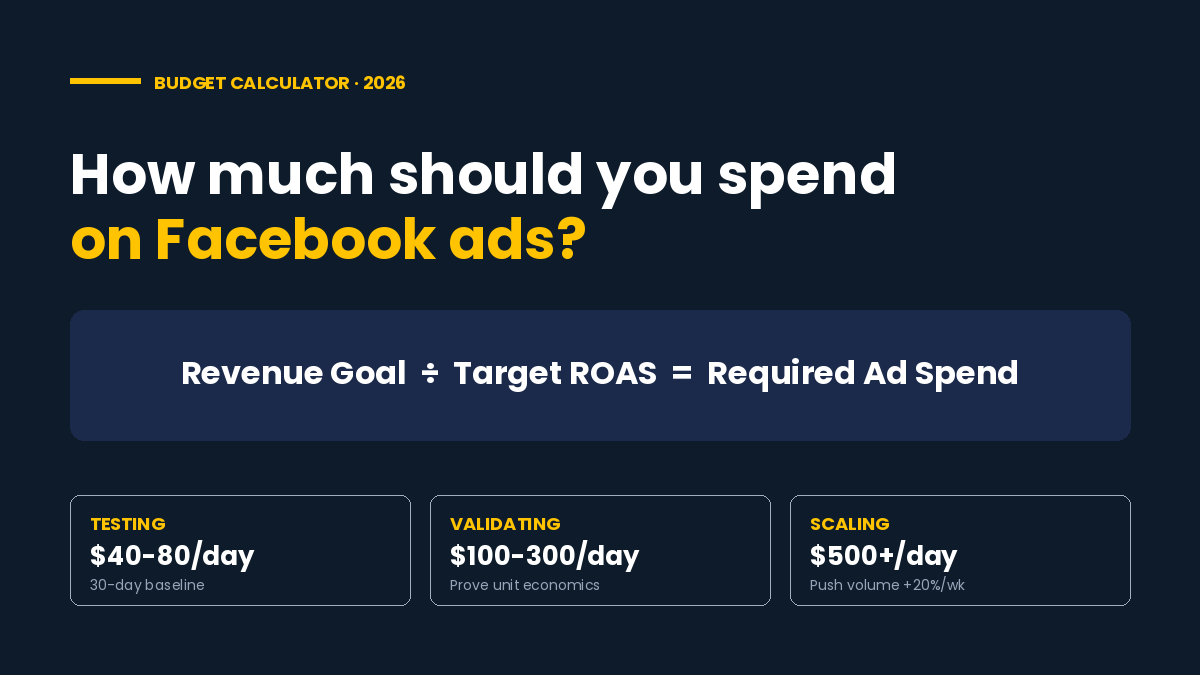
How much should I spend on Facebook ads? Here’s what you’ll learn
- The revenue-first formula: Revenue Goal ÷ Target ROAS = Required Ad Spend.
- How to calculate your break-even ROAS in 30 seconds (and why 1.5x is the magic multiplier).
- The 3 budget tiers (Testing $40–80, Validating $100–300, Scaling $500+) and when to move up.
- The stop-loss math nobody teaches — so you stop burning budget on dead campaigns.
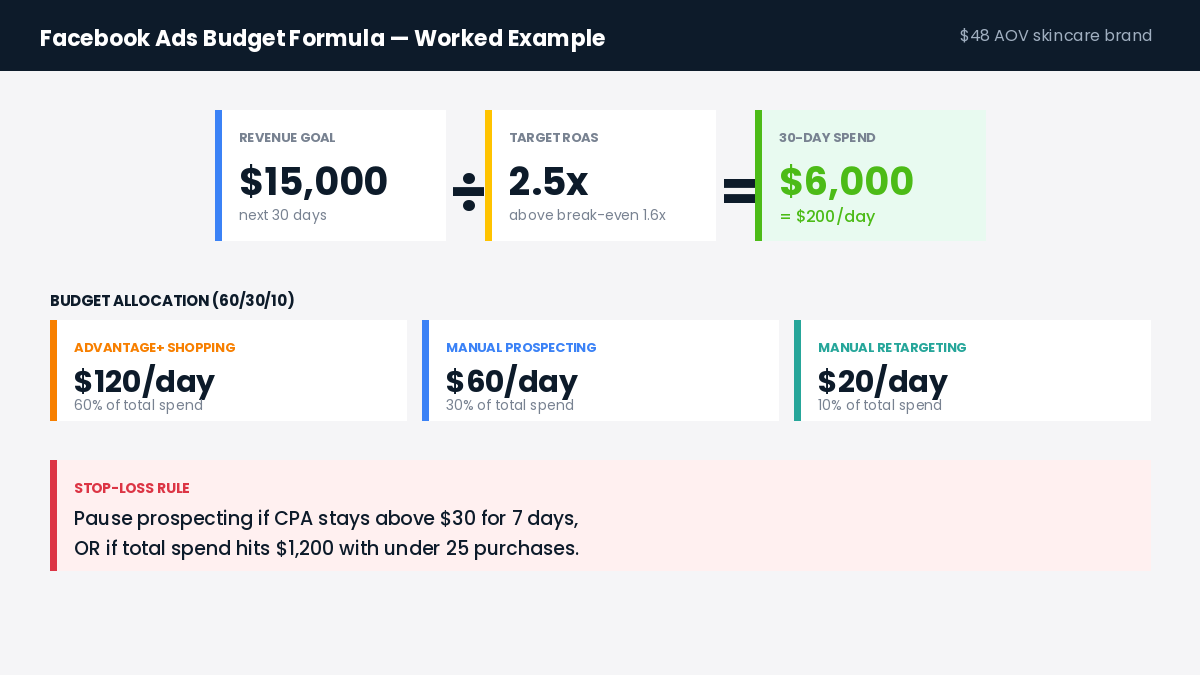
- A worked example: $48 AOV skincare brand to $15K revenue goal.
“How much should I spend on Facebook ads?” is the wrong question.
The right one: what is the smallest daily budget that gives Meta enough data to make decisions for me — and that I can sustain for 30 days without breaking the business?
Below is the formula, the three budget tiers, and the math nobody wants to teach you because it is less viral than “$10/day to start.” It is also the math that actually works.
The simple formula (and why most advice ignores it)
There are two ways to set a Facebook ads budget. Most people use the lazy one. The right one takes 2 minutes and an honest look at your numbers.
The lazy way (do not do this)
“Start with $10/day and scale from there.” This is on 80% of the blog posts that rank for this query, and it is wrong for every ecommerce store. $10/day is below Meta’s minimum learning threshold for most niches — you will not collect enough conversion data in 30 days to know if the campaign works.
The revenue-first formula (do this)
Required Ad Spend = Revenue Goal ÷ Target ROAS
Three inputs: Revenue goal (be specific: $20,000). Realistic Target ROAS (2x if new, your actual blended ROAS if you have 3 months of stable data). Divide. That is your 30-day spend.
Calculate your break-even ROAS
Before you set a target ROAS, you need to know what ROAS keeps the business alive.
Break-even ROAS = 1 ÷ Net Margin %
If your gross margin after COGS, shipping, processing fees, and operating costs is 33%, your break-even ROAS is 1 ÷ 0.33 = 3.03. Anything below that and you are losing money on the sale.
- High-margin (60–75%): skincare, jewelry, supplements, premium apparel. Break-even ROAS 1.4–1.7x.
- Mid-margin (35–50%): mid-price apparel, kitchenware, electronics accessories. Break-even ROAS 2–2.9x.
- Low-margin (15–25%): dropshipping, electronics, low-AOV commodity. Break-even ROAS 4–6.7x.
Your target ROAS should be at least 1.5x your break-even ROAS. Below that, you have nothing left for fixed costs, taxes, and reinvestment.
Step 2: Pick your budget tier honestly
Three tiers based on stage. Skip a tier and you skip the data your next decision needs.
When you have no Meta history, no proven creative, no audience research
When you have proven the funnel and want to scale carefully
When unit economics are validated and you want to push volume
Set the daily budget and allocate across campaign types
Take the 30-day spend from Step 1, divide by 30 — that is your starting daily budget. Then allocate it using the hybrid model:
- 60% to Advantage+ Shopping (only if you qualify with 25+ weekly conversions).
- 30% to Manual prospecting for new audience and creative tests.
- 10% to Manual retargeting for warm-audience cleanup.
If you do not yet qualify for Advantage+ Shopping, run 80% on manual prospecting and 20% on manual retargeting until you cross 25 weekly conversions. The full Advantage+ vs Manual decision framework is in my dedicated comparison post.
Set a stop-loss number
Before you turn the campaign on, decide the number at which you pause and audit.
Pause and audit if CPA stays above 2x your break-even number for 7 consecutive days OR if total spend reaches your testing-tier budget with under 5 conversions.
Without a stop-loss, the campaign runs on autopilot, optimism takes over, and a store can burn $3,000 chasing a campaign the math has been saying no to for three weeks.
The right answer to “how much should I spend on Facebook ads” comes from your revenue goal, not from a YouTube tutorial.
Common budget mistakes I see weekly
Starting at $5/day to “test cheap.” Meta cannot optimize on noise. $5/day collects 4–8 conversions a month, nowhere near learning-phase thresholds. The classic way to spend $300 and learn nothing.
Jumping daily budget by 100% in one move. “CPA looks great, let me 2x the spend.” This resets the learning phase and CPA usually crashes for 5–7 days before stabilizing. Compound 20–25% lifts every 4–7 days instead.
Setting budget without a revenue goal. “$30/day feels safe” is not a strategy. Use the revenue-first formula: Revenue Goal ÷ Target ROAS = Required Spend. That is how you know what number is right for YOUR store, not someone else’s blog.
Not separating testing budget from scaling budget. Treating them as one pool means every new test threatens the budget already working on validated campaigns. Allocate them separately and protect the proven spend.
Frequently asked questions
What is the minimum budget for how much should I spend on Facebook ads in 2026?
Realistically, $40/day or $1,200/month for ecommerce. Below that, you will not collect enough conversion data in 30 days for Meta’s learning phase to stabilize, and you cannot tell whether the campaign would have worked at scale. $5–$10/day budgets are a popular suggestion from generic blog posts and a quiet way to lose $300 over a month with nothing learned.
How much should I spend on Facebook ads for a brand-new Shopify store?
Start in Tier 1 ($40–$80/day) for 30 days minimum. The goal is not ROAS — it is collecting 50 conversion events so your pixel can learn. Once you cross 50 events with a stable CPA, move to Tier 2. Do not skip Tier 1 because Tier 2 budget “looks better.”
How often should I increase my daily budget?
Raise daily budget by 20–25% every 4–7 days as long as your CPA and ROAS hold. Larger jumps (50%+) reset the learning phase and CPA typically swings for 5–7 days. Smaller, regular increases let Meta’s algorithm find new audience pockets at the higher spend without losing the optimization.
Is $10/day enough for Facebook Ads?
Almost never for ecommerce. $10/day collects roughly 8–15 conversions in 30 days at typical ecommerce CPA. That is below Meta’s learning-phase threshold and below the data volume you need to make any real decision about whether the funnel works. $10/day budgets are a way to spend $300 and learn nothing.
How much should I spend on Facebook ads if my ROAS is below break-even?
Stop spending more and fix the underlying problem first. More budget on a sub-break-even campaign just multiplies the loss. Run the 9-point Meta ads not converting on Shopify diagnostic — it is almost always tracking, creative-to-page mismatch, or CPM vs AOV math. None of those get fixed by spending more.
After you know how much to spend on Facebook ads
The next question is what campaign types to put it into. The Advantage+ vs Manual decision framework tells you which split to use. And if your ROAS is below break-even before you even start spending, run the 9-point diagnostic first — more budget on a broken funnel just compounds the loss.
Not sure what budget tier is right for your store?
I’ll look at your AOV, margin, and current Meta data, then tell you exactly what daily budget to run — and what stop-loss to set — in 20 minutes.