 Khandakar Touheed Hossain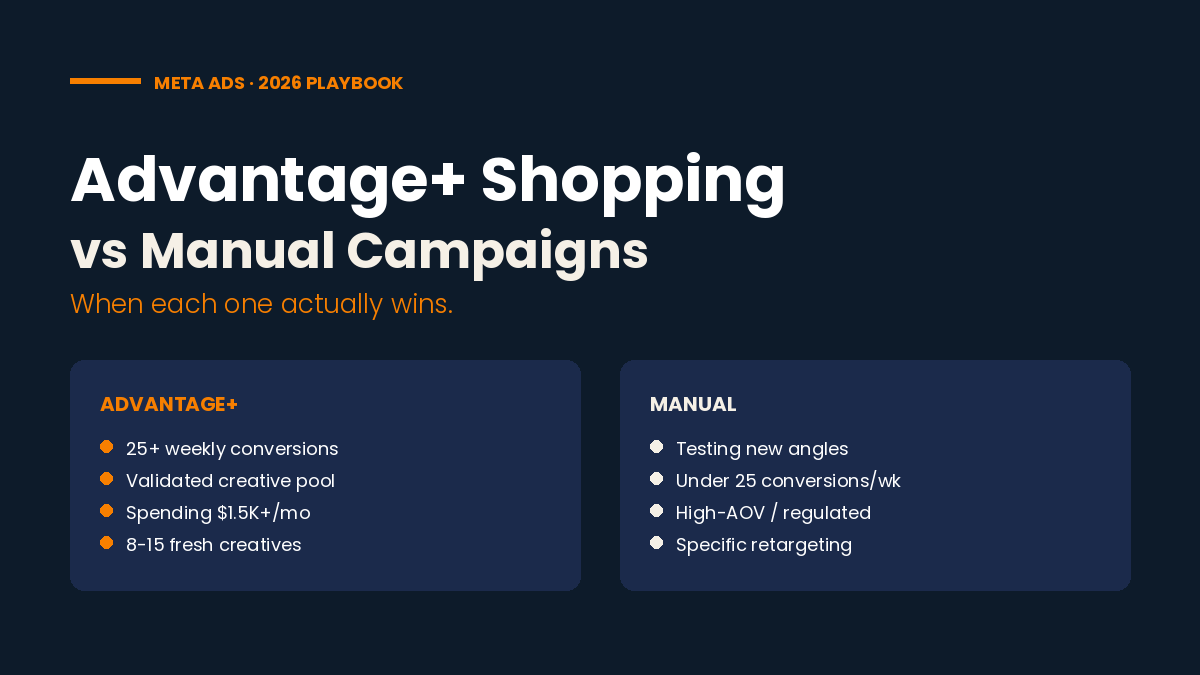
Advantage+ Shopping vs Manual Campaigns in 2026: When Each Wins
What you’ll get from this Advantage Plus Shopping vs Manual guide
- The March 2026 threshold change that flipped this decision for every smaller store.
- A clear “use ASC when X, use manual when Y” rubric (5 conditions each).
- The 60/30/10 hybrid budget split I run on healthy ecommerce accounts.
- The 3 most common ASC mistakes and what to do instead.
- The 4-step decision tree for your next campaign.
Advantage Plus Shopping vs Manual Campaigns was a settled question until March 2026. Then Meta made one quiet change that flipped the decision for every smaller store: the qualifying threshold for Advantage+ Shopping Campaigns (ASC) dropped from 50 conversions per week to 25.
Suddenly, every store doing $5K–$20K a month qualifies for the campaign type that used to be reserved for “big spenders.” And the question I get every week from store owners and other media buyers: should I move my whole budget to Advantage Plus Shopping, or keep running manual campaigns?
The honest answer is “both, but in this split, for these reasons.” Here is the framework I use on every account.
What changed in Advantage Plus Shopping vs Manual in 2026
Three things changed about Advantage+ Shopping in 2026:
- Qualifying threshold dropped from 50/week to 25/week. Smaller stores now qualify.
- Predictive Budget Allocation rolled out — Meta dynamically shifts spend in real time based on predicted conversion probability. Meta reports an 8–15% ROAS improvement for advertisers using it.
- Advantage+ Creative now generates video variations from a single static image and produces up to 150 ad combinations automatically.
Net effect: ASC is more powerful in 2026, more available to smaller stores, and more dependent on the quality of the creative and pixel data you feed it.
When Advantage Plus Shopping vs Manual wins
- You have 25+ Purchase events per week in the last 4 weeks (stable, not seasonal one-offs).
- Your Event Match Quality is 7 or higher (CAPI is properly set up).
- Your catalog has 5+ products that have all sold at least once in the last 60 days.
- You have 6–10 creative variations to give the algorithm enough fuel.
- You are spending $1,500+/mo on Meta ads (below this, Predictive Budget Allocation has too little to optimize).
When manual still wins in the Advantage Plus Shopping vs Manual decision
- You are testing a new product, audience angle, or creative hook — ASC will not isolate signal, manual will.
- You have under 25 weekly conversions and your pixel does not have enough data for ASC to learn from.
- You need to send traffic to a non-product landing page (lead magnet, quiz funnel, application form).
- You need to retarget a specific segment with a specific creative (e.g. abandoned-cart users with a coupon code).
- You are in a regulated or high-AOV niche (legal, financial, B2B SaaS, high-ticket coaching).
The hybrid structure I run for most clients
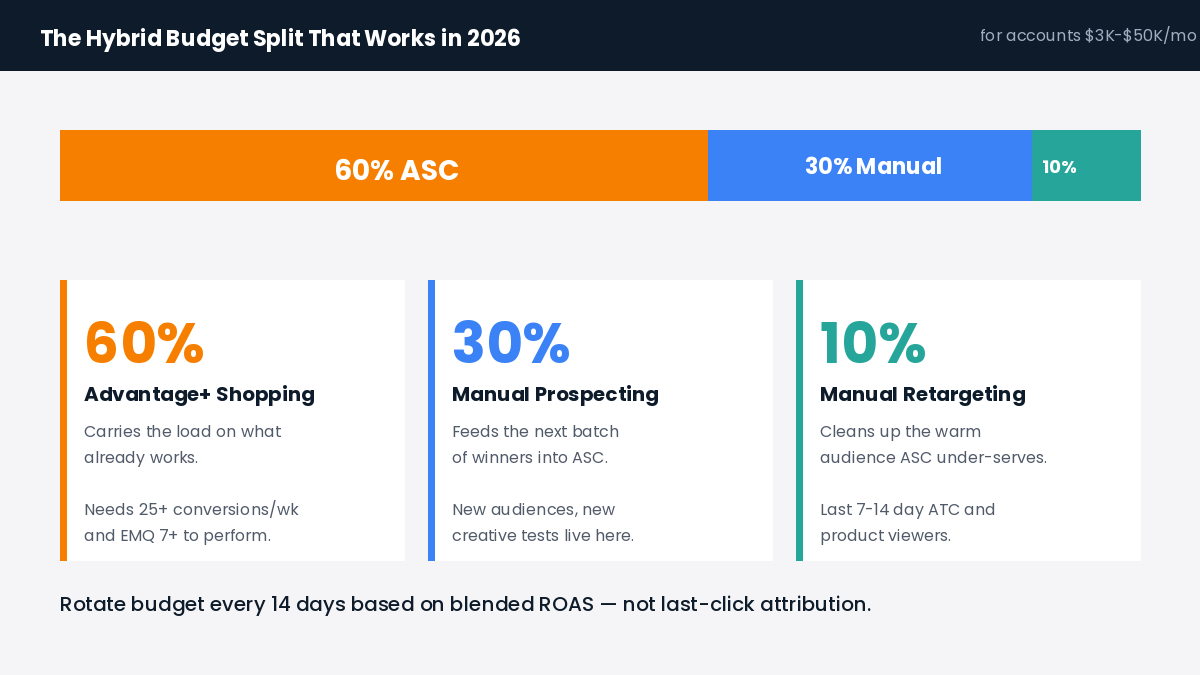
For healthy ecommerce accounts spending $3K–$50K/mo, this is the Advantage Plus Shopping vs Manual split that has performed best for me over the last 6 months:
- 60% of budget — Advantage+ Shopping. Handles efficient scaling on validated audiences and creatives.
- 30% of budget — Manual prospecting. New audience angles, new creative tests, new lookalike sources. Generates the data ASC then uses to scale.
- 10% of budget — Manual retargeting. Tight audiences (recent ATC + recent product viewers, last 7 days) with specific creative.
Why this split works: ASC carries the load on what already works. Manual prospecting feeds the next batch of winners into the pipeline. Manual retargeting cleans up the warm audience ASC under-serves because of its broad-audience preference.
ASC scales validated winners. It does not invent them. Manual is where you produce the next batch.
The 3 biggest Advantage Plus Shopping vs Manual mistakes I see in 2026
Each one I see at least 5 times a month across client account audits. Avoid these and you will outperform 80% of stores running ASC.
Launching ASC with under 25 weekly conversions
The new threshold says you qualify. It does not say you should. Below 25 conversions/week, ASC will burn $300–$500 trying to find a learning pattern in too little data. The algorithm needs a stable signal before it can optimize.
Feeding ASC the same 3 creatives you have run for 6 months
ASC tests up to 150 creative combinations automatically. If you give it 3 inputs, you are wasting the engine. The accounts that win ASC are the ones that ship 8–15 fresh creatives a month. The accounts that lose ASC are the ones that say “I gave it our hero video, why is ROAS dropping?”
Killing ASC at day 3 because CPA looks “wrong”
ASC needs 7–10 days to stabilize. Day 3 numbers are noise. Most “ASC does not work” stories are actually “ASC paused at day 2” stories.
Predictive Budget Allocation — the under-discussed lever
Predictive Budget Allocation rolled out in March 2026 and most operators are still not using it correctly. It shifts your daily budget between ad sets in real time, based on the predicted conversion probability of each. Meta reports an 8–15% ROAS lift for advertisers who use it vs those who manage budgets manually at the ad set level.
To turn it on: in your ASC campaign settings, enable Campaign Budget Optimization (CBO) and check the Predictive Budget Allocation toggle. Then stop touching the budget for 14 days. The lift compounds over time.
A simple Advantage Plus Shopping vs Manual decision tree for your next campaign
-
1
Do you have 25+ weekly conversions and Event Match Quality 7+? If no, stay manual. If yes, continue. -
2
Do you have 8+ fresh creatives? If no, produce them first, then continue. -
3
Are you spending $1.5K+/mo on Meta? If no, start with one ASC campaign at 30% of budget, keep 70% manual. If yes, go to the 60/30/10 split. -
4
Wait 14 days. Compare ASC blended ROAS to your manual baseline. If ASC is +15% or more, shift another 10% of budget. If ASC is below baseline, audit creative volume and EMQ before changing the budget split.
Before you even start this decision: if your Event Match Quality is below 7, the Advantage Plus Shopping vs Manual question does not matter yet. ASC will starve. Manual will run on bad data too. Fix your Conversions API Shopify setup first, then come back to this framework.
Frequently asked questions
Can I run only Advantage Plus Shopping and no manual campaigns at all?
You can, but you lose the test bed for new audiences and creative angles. ASC scales validated winners — it does not invent them. Most accounts that go 100% ASC plateau within 2–3 months because they run out of fresh signal to feed it. Keep 30% in manual to keep the pipeline of new winners alive.
How long does it take to know if Advantage Plus Shopping vs Manual is working?
14 days minimum for a fair read. The first 7 days are the learning phase, days 8–14 are stable performance. Day-3 reads are noise. If at day 14 ASC is below your manual blended ROAS, audit creative volume and CAPI Event Match Quality before pausing.
Does Advantage Plus Shopping work for high-AOV products ($500+)?
It can, but Meta needs more conversions per week to learn at that AOV. Above $500 AOV, you typically need 35–50 weekly conversions for ASC to stabilize, not 25. Below that volume, manual campaigns with a tighter audience usually outperform.
Should I turn on Predictive Budget Allocation in manual campaigns too?
Yes, when running CBO. The same 8–15% ROAS lift applies. The only time to turn it off is when you are actively testing ad sets against each other and need even budget distribution for a clean read.
If my Meta ads are not converting, should I switch to Advantage Plus Shopping?
Not as a fix. Switching to ASC will not solve broken tracking, poor creative-to-page match, or a slow product page. Run the 9-point Meta ads not converting on Shopify diagnostic first. ASC scales what already works — it does not rescue what does not.
After the Advantage Plus Shopping vs Manual decision is made
Once your split is dialled in, the next question is how much to actually spend. Use this 2026 Facebook ads budget calculator to size your daily spend against your revenue goal and break-even ROAS. The 60/30/10 split only works if the total budget is sized correctly to begin with.
Want to know if ASC or Manual is right for your account?
I’ll open your Ads Manager, look at your conversion volume, EMQ and creative pool, and tell you exactly which split to run — in 20 minutes. No pitch, just numbers.