 Khandakar Touheed Hossain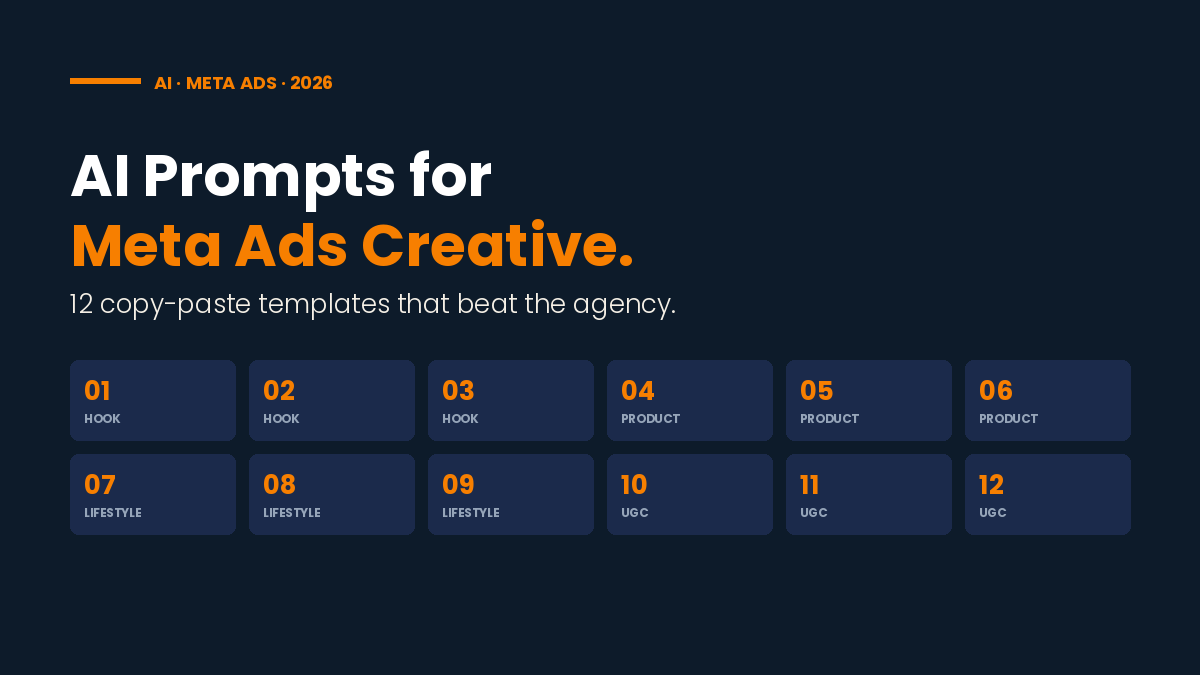
AI Ad Creative Prompts for Meta Ads: 12 Templates That Beat the Agency
What you’ll get from these AI prompts for Meta ads
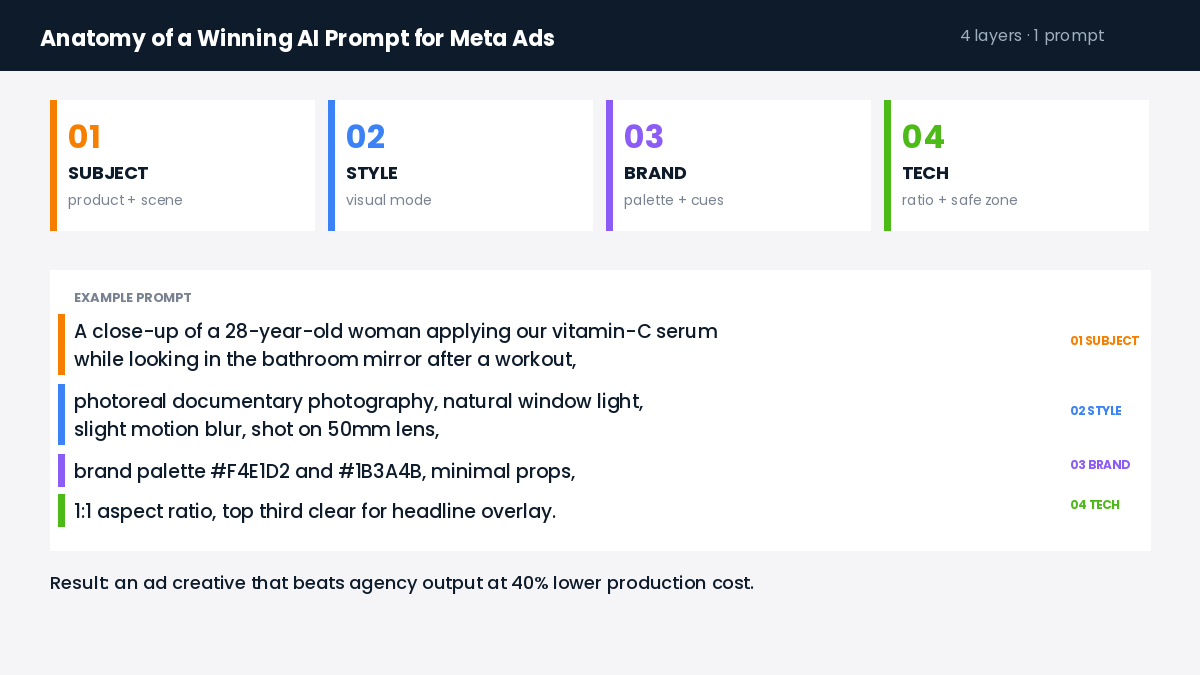
- The 4-layer prompt structure I use for client ad creative (subject, style, brand, tech).
- 12 copy-paste prompt templates organized by ad angle: hook, product showcase, lifestyle, UGC mimicry.
- Why generating one image is the biggest mistake operators make — and what to do instead.
- The structured 7-day test framework for AI creative in Meta Ads Manager.
- The 5 mistakes that turn AI prompts for Meta ads into stock-photo factories.
Most “AI prompts for Meta ads” advice gets you a stock-photo-quality ad with a product floating in front of a gradient. The algorithm ignores it. You wonder why your creative is not converting.
Real AI-generated ad creative — the kind that beats agency-produced creative at 40% lower cost — needs a structured prompt. Not a sentence. A four-layer specification that tells the model exactly what scene, style, brand cues, and technical specs to produce.
Below is the 4-layer prompt structure I use for clients, followed by 12 copy-paste prompt templates organized by ad angle. Use them in Midjourney v7, DALL-E 4, AdStellar, or any modern image model.
Why most AI prompts for Meta ads fail
Three reasons:
- They describe the product, not the scene. Meta’s algorithm rewards creative that stops the scroll because of context (a person, an emotion, a story) — not because of the product itself.
- They forget the brand cues. The output looks like every other AI-generated product shot on the platform. No palette, no typography, no recognizable identity.
- They ignore the technical specs (aspect ratio, file format, safe zones for text overlays). Output is gorgeous and unusable in Ads Manager.
The 4-layer structure of AI prompts for Meta Ads that convert
Every prompt I write for client ad creative follows this structure. Skip any layer and you get a stock photo.
Subject (product + scene)
Describe what the product is, who is using it, where, and how. “A 28-year-old woman applying our serum after a workout” — not “a serum bottle on a marble table.”
Visual style
Photoreal documentary, editorial fashion, 3D render, flat vector, retro film grain, hand-shot iPhone UGC. Match the placement — UGC look outperforms editorial polish on Reels.
Brand cues
Palette (hex codes), typography references, logo placement, supporting props that signal your brand world. Without this layer, every AI ad looks generic.
Technical specs
Aspect ratio (1:1 Feed, 9:16 Reels, 4:5 Feed-optimized), safe zone for text overlay (top/bottom third clear of face), no on-canvas text.
12 AI prompts for Meta Ads — organized by ad angle
Replace the bracketed placeholders with your specifics. Generate 6–12 variations per prompt — the model needs volume to nail the brief.
Hook prompts — the scroll-stoppers
Use these for cold prospecting. The goal is the first 0.8 seconds of attention.
HOOK
Reaction shot
HOOK
Pattern interrupt
HOOK
Before/After implied
Product showcase prompts — for warm-audience retargeting
These convert higher in retargeting because the audience already knows the brand and wants product detail.
PRODUCT
Hero macro
PRODUCT
Product family flat-lay
PRODUCT
In use, no face
Volume beats polish. Generate 10 variations per prompt and pick the two strongest.
Lifestyle prompts — for awareness and TOFU
These ads do not push the product hard — they sell the lifestyle the product enables.
LIFESTYLE
Morning ritual
LIFESTYLE
Friendship moment
LIFESTYLE
Aspirational outcome
UGC mimicry prompts — for TikTok and Reels native feeds
These look like the customer made them. Native feel beats polish on short-form video placements.
UGC
Founder talking head
UGC
Unboxing moment
UGC
Honest review
Before you generate — pull competitor ads first
Open Meta Ads Library. Filter by your category and country. Pull 20–40 active ads and sort them by the four angles above (hook, product showcase, lifestyle, UGC).
You will see which angles are winning in your niche. Then generate 6–12 variations per angle using the templates above. That is statistical volume — anything less and you cannot tell signal from noise.
How to test AI prompts for Meta Ads properly
-
1
Group the 12 generated creatives into 4 ad sets by angle (3 hooks, 3 showcases, 3 lifestyle, 3 UGC). -
2
Run them in a manual campaign with a $40–$60/day budget per ad set, broad audience targeting, optimize for Purchase. -
3
Hold for 7 days minimum. Do not pause individual creatives — let the learning phase finish. -
4
After 7 days, identify the top-performing creative per ad set. Pause the bottom two in each ad set. -
5
Take the 4 winning creatives (one per angle) and feed them into your Advantage+ Shopping campaign as the new creative pool. -
6
Replace any creative in ASC that has been running for 21+ days — Meta’s creative fatigue threshold is shorter than most operators think.
Mistakes I see weekly with AI prompts for Meta Ads
Generating one prompt, getting one image, calling it the campaign. The model needs 10–20 generations per angle to find one that nails the brief.
Skipping the brand cues layer. Output looks generic, blends into every other AI-generated product shot on the platform, gets ignored.
Generating square images and forcing them into 9:16 placements. Reels and Stories punish letterboxed content. Generate native to the placement aspect ratio.
Treating AI as a full replacement for UGC. AI is great for hooks, product showcase, and concept art. Real UGC (creator partnerships, customer videos) still beats AI for trust signals.
Forgetting to test against your existing top creative. AI ads only count as “winning” if they beat what is already in the account.
Frequently asked questions
Which AI tool works best with AI prompts for Meta Ads in 2026?
Midjourney v7 leads for photoreal portrait and lifestyle. DALL-E 4 leads for product macro and clean studio shots. Ideogram leads for any creative needing legible on-canvas text (logos, product packaging detail). For end-to-end ad generation including the campaign build, AdStellar and AdAmigo automate the workflow but charge per creative.
Can AI prompts for Meta Ads fully replace a creative agency?
For static image ads, increasingly yes. Production cost drops 40–60% with no quality penalty for hook and product-showcase angles. For video ads, lifestyle moments, and UGC mimicry, AI tools still produce uncanny-valley artifacts that buyers notice. Best practice: AI for 60–70% of creative volume, real production for the 30–40% that needs human authenticity.
Do AI-generated ads get flagged by Meta?
No, Meta does not flag AI-generated ads as a category. They review on the same standards as any other creative (no misleading claims, no prohibited content, no excessive text on image). AI-generated ads pass review at the same rate as human-produced ads.
How many AI prompts for Meta Ads should I test for a new product launch?
Minimum 12 — three per ad angle (hook, product showcase, lifestyle, UGC). Generate 6–10 image variations from each prompt, pick the strongest two per prompt, run all 24 variations in a structured ad-set test for 7 days. The volume is what gives you statistical signal — small tests on AI creative produce inconclusive results.
Do AI prompts for Meta Ads work for retargeting campaigns too?
Yes, but use the product-showcase and UGC categories — not the hook category. Retargeting audiences have already seen your brand. Lead with product detail (macro, in-use) and social proof (UGC review). Reserve hook prompts for cold prospecting. Pair with the right campaign type using the Advantage+ vs Manual decision framework.
Once your AI prompts for Meta Ads are shipping winners
Creative volume is half the equation. The other half is what platform you spend on and how. Pair these templates with the TikTok vs Meta ads platform fit guide to decide where your creative goes, and the Advantage+ vs Manual framework to decide what campaign type runs them. And if a winning creative still does not convert, run the 9-point Shopify diagnostic — the problem is usually tracking, not the ad.
Want me to look at your current ad creative?
I’ll open your Meta Ads Library, look at what is running, and tell you which AI prompt categories will lift your CTR fastest. 20 minutes, no pitch.